We supply, install and maintain car park gas detection for underground, basement and enclosed multi-storey car parks across Ireland. Our systems measure carbon monoxide and nitrogen dioxide and control the ventilation fans, so the air stays safe and the fans only work hard when they need to.

Every car that starts, queues or circles for a space adds exhaust to the air. Petrol engines produce carbon monoxide. Diesel engines produce nitrogen dioxide as well. Both gases are harmful to breathe, and carbon monoxide has no colour or smell, so people cannot tell when levels are rising.
In an open-sided car park, wind clears most of it. Underground car parks and enclosed levels rely on ventilation. A carbon monoxide detection system, paired with a nitrogen dioxide detector where diesel traffic is significant, tells you whether that ventilation is doing its job. We explain the diesel side in more detail in our guide to nitrogen dioxide in car parks.
Technical Guidance Document F (Ventilation), 2019 edition, sets out approaches for car parks below ground level, enclosed car parks and multi-storey car parks. For natural ventilation it describes permanent openings at each level equal to at least 1/20th of that level’s floor area, with at least 25% on each of two opposing walls. For mechanical ventilation it describes either permanent openings of at least 1/40th of the floor area plus a system capable of at least three air changes per hour, or, for basement car parks, a system capable of at least six air changes per hour. Exits and ramps where cars queue with engines running should have a local rate of at least ten air changes per hour.
TGD F also allows other ventilation systems that limit the mean predicted carbon monoxide level to not more than 30 ppm averaged over 8 hours, with peaks near ramps and exits not more than 90 ppm for periods up to 15 minutes. Gas detection linked to the fans is a common way to manage ventilation against those levels. Your design team or building control adviser will confirm which approach applies to your building.
Running car park fans at full speed all day is expensive and noisy. With ventilation fan control, sensors spread across each level report gas levels to a central panel. When the air is clean, fans run at low speed or stand by. When carbon monoxide or nitrogen dioxide rises past a set level, the panel brings the fans up to speed. If levels keep rising, a second alarm stage can trigger sounders, beacons and warning signs.
The result is ventilation that responds to traffic. Busy periods get more air, quiet nights use less power, and you have a record of what the system has done.
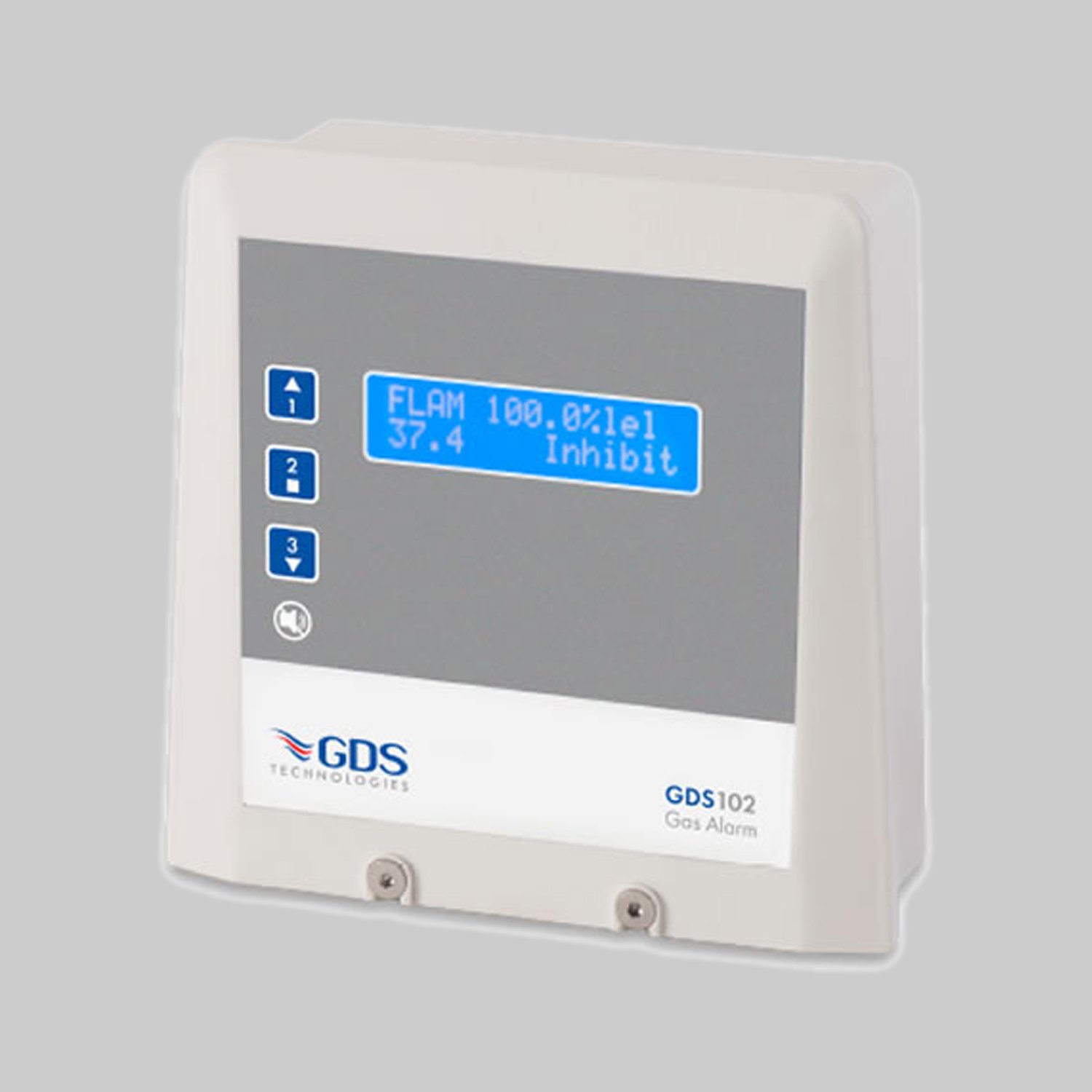
For most car parks we recommend the GDS Combi addressable gas detection system. An addressable system lets many sensors share one network cable, with each sensor reporting its own reading and status to the panel. That keeps cabling simpler across large floor plates and multiple levels, and it shows you exactly which sensor has picked up gas.
The GDS Combi is used in car parks, tunnels and plant rooms. It takes up to 64 addressable sensors on a single 4-core sensor network, offers three alarm levels, and has optional addressable relay boards that we use to switch fans, sounders and beacons. Controllers can be networked together for larger sites.
Car park sensors work in a harsh place. Exhaust, dust, damp and temperature swings all cause drift, and a sensor that reads low will leave the fans idle when they should be running. Regular calibration with certified test gas keeps the readings honest.
Our gas detection maintenance contracts cover scheduled calibration, checks on fan and alarm outputs, and priority response if something goes wrong. Our database flags a month in advance when your service is due.
Where a meaningful share of vehicles are diesel, NO2 can be the gas that rises first. Many modern car park systems monitor both. We look at your traffic and layout before recommending a sensor mix.
It depends on the floor area, the layout, ramps, exits and where cars queue. We survey the car park and design sensor positions to cover each level, with extra attention to ramps and exits.
Usually, yes. The detection panel connects to the existing fan controls. We check the fans and controls on site to confirm how they can be linked.
Yes. For people who work in the car park, the HSA’s 2026 Code of Practice for the Chemical Agents Regulations sets occupational exposure limit values. For carbon monoxide these are 20 ppm over 8 hours and 100 ppm over 15 minutes. For nitrogen dioxide they are 0.5 ppm over 8 hours and 1 ppm over 15 minutes.
Yes. Our engineers service and calibrate gas detection equipment from many manufacturers, not only the brands we supply.
Send us the car park drawings or tell us the number of levels and spaces, and we will arrange a survey and recommend a system. Call 01 289 7720 or email info@vistec.ie.
© 2026 Vistec Gas Detection Ltd
Descriptions