We supply, install and service fixed CO2 monitors and carbon dioxide detection systems for pubs, hotels, breweries, labs and schools across Ireland. A CO2 monitor watches the air where carbon dioxide is stored or produced and raises an alarm before levels become dangerous.
Carbon dioxide has no colour and, at the levels that matter, no smell people can rely on. It is heavier than air, so a leak sinks and gathers at floor level, in cellars, pits and low corners. As it builds up it does two kinds of harm. It is harmful to breathe in its own right, and in larger amounts it pushes out the oxygen in the room.
Because CO2 can cause harm before oxygen levels fall far, it is best measured directly with a dedicated CO2 sensor rather than relying on an oxygen sensor alone. In rooms where CO2 and other inert gases are both in use, the two are often fitted together.
Most pubs, hotels and restaurants use CO2 cylinders for drinks dispense. Cylinders, regulators and gas lines all sit in the cellar, often a small, below-ground room with limited ventilation. A loose fitting or a failed regulator can fill it with gas, and the next person down the steps walks straight into it. The HSA lists cellars among the places that can be confined spaces.
A beer cellar CO2 alarm uses a sensor mounted low in the cellar, a control unit, and an audible and visual warning outside the cellar door, so staff know not to go in. We can also link the system to a valve or ventilation fan where the layout allows.
Fermentation produces carbon dioxide. In a brewery, distillery or winery, that gas comes off fermentation vessels and can collect in the room, in pits and around tank bases. Larger sites also store bulk CO2 for carbonation and dispense.
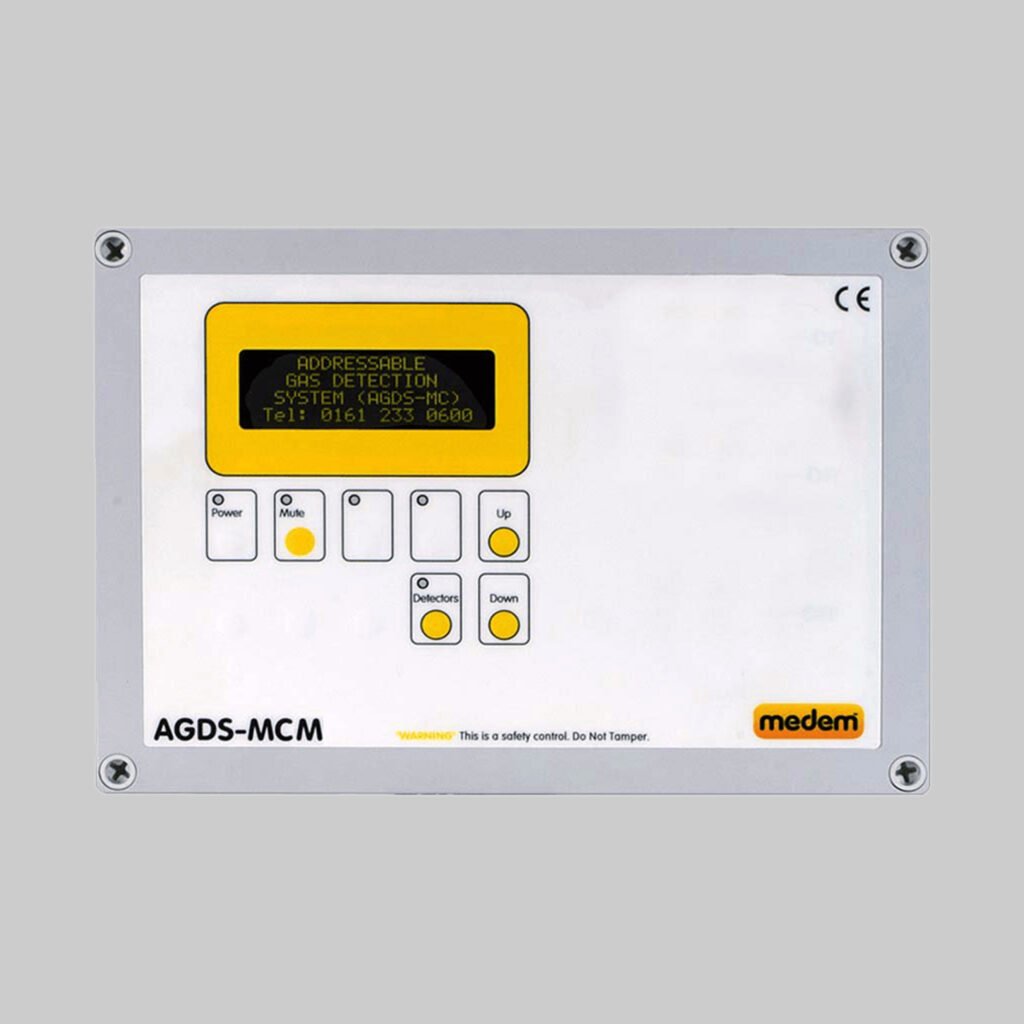
Brewery CO2 detection usually needs several sensors placed low around vessels, tank rooms and stores, linked to a central panel with alarms and ventilation control. Our fixed gas detectors range covers single sensor units through to multi-channel systems. For smaller rooms, compact one and two channel controllers such as the Medem AGDS 2EM are worth a look, and we will confirm the right sensor and controller for your site.
Schools use carbon dioxide in two ways. In science labs, CO2 cylinders and incubators are a safety risk, the same as in any research lab. We cover these, along with nitrogen and oxygen depletion, on our laboratory gas detection page.
In classrooms, CO2 levels are widely used as an indicator of how well a room is ventilated. People breathe out carbon dioxide, so a rising reading in an occupied room is a sign that fresh air is not getting in fast enough. A fixed CO2 monitor gives a continuous reading and a clear signal to open windows or increase ventilation.
Because carbon dioxide is heavier than air, sensors are mounted low, near the floor and close to the likely source of a leak, such as cylinders, manifolds or fermentation vessels. The alarm display and warning should be outside the room, so the reading can be checked before anyone goes in.
Like all gas sensors, CO2 sensors need regular calibration with certified test gas to stay accurate.
The HSA’s 2026 Code of Practice for the Chemical Agents Regulations sets an occupational exposure limit value for carbon dioxide of 5,000 ppm over an 8 hour reference period. Alarm levels on a CO2 monitor are set with this in mind, and we agree them with you at installation.
Any cellar with CO2 cylinders carries a leak risk, and small cellars fill fastest. Your risk assessment should decide, and we can help you work through it. A single sensor system is usually enough for a small cellar.
Yes. Most fixed systems have relay outputs that can start an extract fan when CO2 rises, as well as sounding an alarm.
Yes. Our engineers service and calibrate gas detection equipment from many manufacturers, not only the brands we supply. Tell us the make and model when you get in touch so we bring the right test gas.
Not on its own. Carbon dioxide can be harmful at levels where the oxygen reading has barely changed. A dedicated CO2 sensor gives a direct and earlier warning.
Tell us where your CO2 is stored or produced and we will recommend sensor positions and the right system. Call 01 289 7720 or email info@vistec.ie.
© 2026 Vistec Gas Detection Ltd
Descriptions